Press & Media
For journalists, podcasters, event organizers, and publishers — everything you need in one place.
Available for interviews, podcasts, panels, and talks: samir@samirvarma.com
At a glance
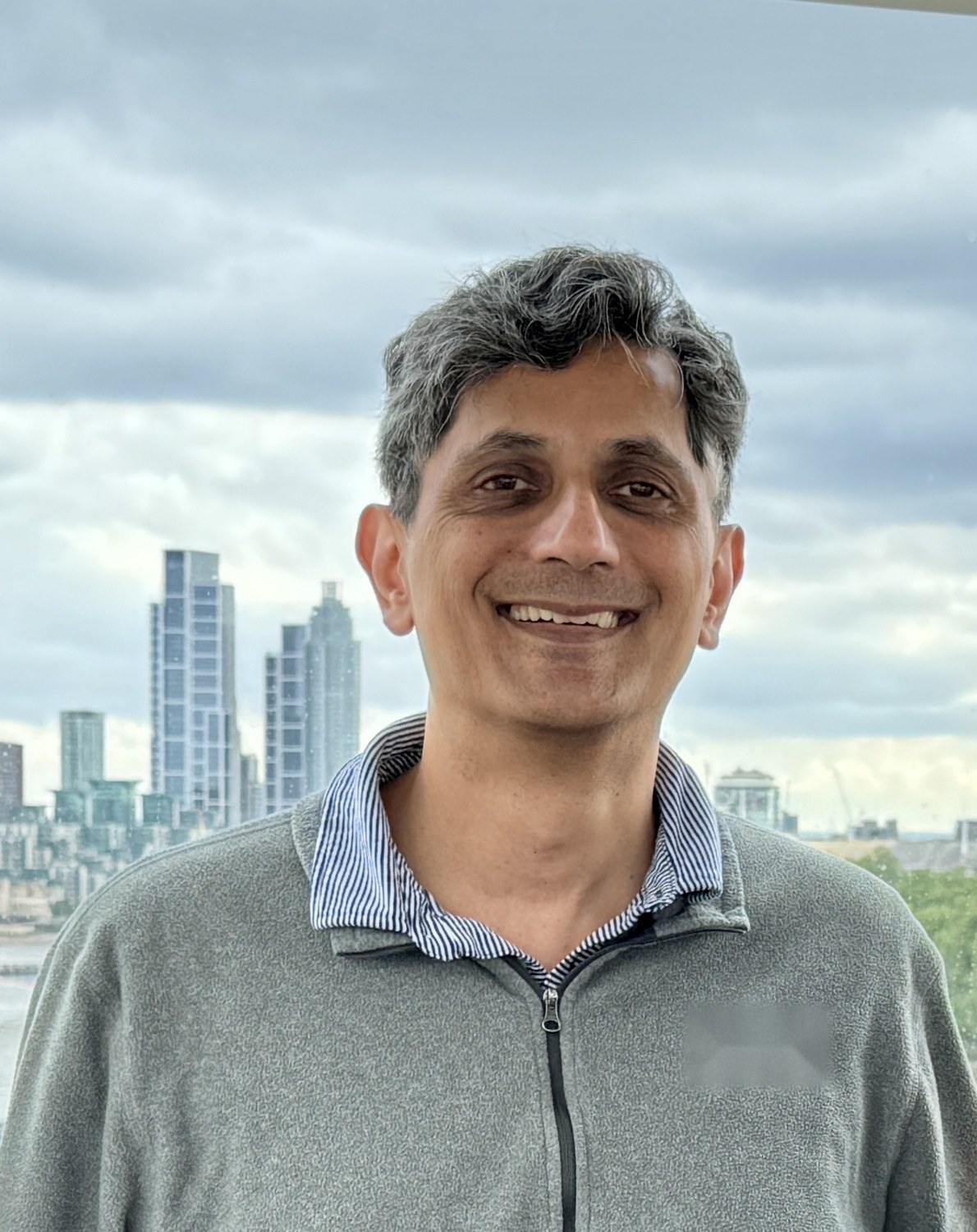
- Headshot: Download high-resolution photo (JPG)
- Press kit (book): The Science of Free Will press kit (PDF)
- Email: samir@samirvarma.com
- X / Twitter: @samirvarma
- LinkedIn: samir-varma-0806b
Short bio (50 words)
Samir Varma is a physicist, hedge-fund founder, author, and inventor whose work connects deterministic systems: particles, markets, AI, and human choice. He is the author of The Science of Free Will (Iff Books, 2025), founder of VS Asset Management, and inventor on eight US patents spanning AI, finance, and traffic systems.
Long bio (≈200 words)
Samir Varma is a theoretical physicist, hedge-fund founder, author, and inventor whose work bridges physics, finance, and the philosophy of mind. He holds a PhD in theoretical particle physics from the University of Texas at Austin, where the late E.C.G. Sudarshan was his advisor and the late Nobel Laureate Steven Weinberg served on his dissertation committee, and a BS in Electrical Engineering from Columbia University.
He is the author of The Science of Free Will: How Determinism Affects Everything from the Future of AI to Traffic to God to Bees (Iff Books, 2025, foreword by Tyler Cowen), and a co-editor and chapter contributor for Quantum Theory Meets Gravity (IntechOpen, 2025). He is currently editing a forthcoming IntechOpen volume on investor behavior and investment strategies.
Varma founded VS Asset Management in 2001, where he built and runs Risk Timing®, a systematic US equity strategy with explicit drawdown management. He co-founded Palm Energy Systems (solar) and was Chairman and Chief Scientist of Applango Systems (AI for enterprise software). He is the inventor on eight US patents.
He lives in Connecticut. The Science of Free Will is his first general-audience book.
Speaking topics
I'm available for podcasts, panels, academic talks, and corporate events. Topics I'm comfortable on at length:
- Free will, determinism, and AI — what physics actually says about choice, why "Free Will in Theory" and "Free Will in Practice" are not the same question, and what that means for AI ethics, legal systems, and personal responsibility.
- Quantum mechanics meets gravity — the semiclassical frontier, the double-slit experiment in curved spacetime, and where the two great theories of physics genuinely meet.
- Markets, regimes, and risk classification — why prediction fails, why classification works, and how Risk Timing® applies physical-systems thinking to portfolio construction.
- Where academic finance theory fails in practice — the gap between modern portfolio theory and what actually happens in markets, drawn from twenty-plus years running money.
- Patents, invention, and entrepreneurship — building businesses across AI, traffic, finance, and energy.
- India, geopolitics, and global markets — particularly India–Pakistan dynamics, Indian capital markets, and the diaspora investor lens.
Suggested interview questions
Starter questions; feel free to use, adapt, or skip:
- What inspired The Science of Free Will, and how does your background in physics and entrepreneurship shape your perspective?
- Can you explain in plain language how modern physics challenges traditional notions of free will?
- You distinguish "Free Will in Theory" from "Free Will in Practice." What's the difference, and why does it matter?
- How might understanding determinism change the way we think about personal responsibility, ethics, and the legal system?
- Your book argues AI ethics depends on the free-will question. How?
- You run a hedge fund built on physics-style risk classification. How is that different from forecasting?
- What is computational irreducibility, and why does it matter for free will?
- How might our understanding of free will evolve as brain–computer interfaces and advanced AI mature?
Featured testimonials
I am delighted to see this work come to fruition. Samir Varma breaks down barriers in this fascinating book on determinism … you are part of the causal chain steering your actions in complex, unpredictable ways.
— Tyler Cowen, NYT-bestselling author and Professor of Economics, George Mason University
An intellectual tour-de-force … weaves an exhaustive interdisciplinary study through science, mathematics, computer science, and philosophy.
— Silas Beane, Professor of Physics, University of Washington
A wonderfully entertaining case for determinism. I learned a lot about wave functions, computability and Artificial Intelligence.
— Alex Tabarrok, Bartley J. Madden Chair in Economics, Mercatus Center, George Mason University
Podcasts and interviews
A selection of recent appearances, grouped by theme.
Free will, AI & philosophy
- WorldXPPodcast with neurosurgeon Ted Schwartz — about free will; life is a miracle because free will doesn’t exist under the laws of physics.
- Good Is In The Details — Gwendolyn Dolske and Rudy Salo on Free Will, AI, and what it means practically.
- With @Beescornerofyt — a fun conversation about social influence and its effect on free will.
- Future of Life Institute — on AI: “We Created AI — Why Don’t We Understand It?”.
- Connecting With Coincidence with Bernard Beitman — meaningful coincidences.
- A conversation with the philosopher Nathan Hawkins.
- WorldXPPodcast — about religion, God & free will.
Markets & trading
- Algorithmic Advantage Podcast with Simon M. — Part 2: trading.
- TitansOfTomorrow with Waqar — a conversation about trading.
- WorldXPPodcast — about investing, banking, inflation, housing, regulation, and much more.
- WorldXPPodcast with Jon Turek — Trump tariff conversation.
Physics
- Algorithmic Advantage Podcast with Simon M. — Part 1: quantum physics, determinism, AI, Asimov’s laws of robotics, and why academic finance theory often fails in practice.
- WorldXPPodcast with Djordje Minic and Tristan Hubsch — a new and testable way of incorporating gravity into quantum mechanics. Their upcoming book: The Weight Of The Quantum.
India & current affairs
General / overview
- World XP Podcast — author, physicist, entrepreneur, inventor, and hedge fund manager.
- CT Digital Forum with Jarvis Cromwell. Our segment begins around the 1:19:30 mark.
- Ben Yeoh Chats — general.
Press contact
- Author: Samir Varma — samir@samirvarma.com
- Publisher (book): Iff Books / Collective Ink — Steve Wagstaff, steve.wagstaff@collectiveinkbooks.com · collectiveinkbooks.com/iff-books/
- Distributors: National Book Network (US) · Wiley & Sons (UK)