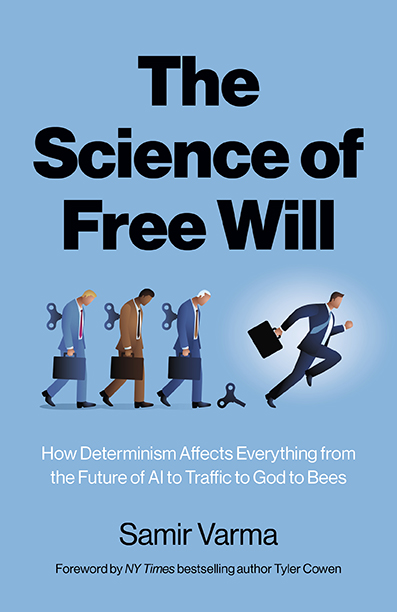
The Science of Free Will
How Determinism Affects Everything from the Future of AI to Traffic to God to Bees. Foreword by Tyler Cowen.
International options (Canada, UK, Germany, Australia, Singapore, France, South Africa, India)
If the laws of physics fully determine the motion of every atom in your body, in what sense do you have free will?
That is the question this book answers — and the answer is not what either side of the usual debate expects. Free will in theory is impossible: physics leaves no room for it. Free will in practice is perfect: the universe is computationally irreducible, your decisions can't be predicted in advance, and you really are part of the causal chain that steers your actions. Both can be true at the same time, and the book shows why.
The argument runs through quantum mechanics, neuroscience, computation, and AI — but never gets stuck there. We are all made of atoms — the same atoms as the rest of the universe. Carbon, hydrogen, oxygen, nitrogen, calcium, and phosphorus, made of electrons, quarks, and gluons, every one of them obeying precise mathematical laws we have known for a century. The free-will question is what happens when you take that fact seriously. Along the way to answering this question, we talk about all kinds of really cool stuff:
- Can subatomic particles exhibit free will?
- What does quantum randomness say about human choices?
- Does chaos theory undermine free will, or does it reinforce the unpredictability essential for autonomous decision-making?
- How do our legal and cultural concepts of fate align with scientific understanding?
- Could advanced AI systems ever achieve genuine agency or consciousness?
And then we can have some fun!
- Do bees have emotions?
- Why don’t we trade with ants?
- Is free will necessary for morality and justice?
- What do traffic jams reveal about choice and inevitability?
- How do notions of fate across cultures relate to modern science?
- Are we living in a simulation, and if so, what does that mean for free will?
I explore these questions, and many others, through the lenses of physics, computation, neuroscience, and more, offering a multifaceted view of free will.
Endorsements
I am delighted to see this work come to fruition. Samir Varma breaks down barriers in this fascinating book on determinism. Even if physics leaves no room for free will in theory, you effectively have ‘Free Will in Practice’—you are part of the causal chain steering your actions in complex, unpredictable ways. I thoroughly enjoyed this book and believe many readers will gain profound insights from it.
— Tyler Cowen, NYT-bestselling author and Professor of Economics, George Mason University
The Science of Free Will is a wonderfully entertaining case for determinism. I learned a lot about wave functions, computability and Artificial Intelligence. Was I convinced that I lack free will? Well, no. But that can hardly be blamed on the author! Convinced or not, I learned a lot, enjoyed the book, and I predict you will too!
— Alex Tabarrok, Bartley J. Madden Chair in Economics, Mercatus Center, George Mason University
An intellectual tour-de-force, this book delves into the timeless debate surrounding free will’s existence. Bridging theory and practice, it weaves an exhaustive interdisciplinary study through science, mathematics, computer science, and philosophy. With compelling evidence and insightful caveats, it challenges readers to reconsider the boundaries between determinism and human agency.
— Silas Beane, Professor of Physics, University of Washington
A thrilling intellectual adventure exploring one of life’s greatest mysteries—do we really have free will? This book takes readers on a rollercoaster ride through cutting-edge physics, avant-garde computer science, and mind-bending philosophy to resolve this age-old paradox once and for all.
— Salman Khan, Founder & CEO, Stabilis Capital Management
Guilt. Accountability. Hard work. Success. Romance. Corporate strategy. War. Ethics. Individual purpose. These and many other critical facets of human existence are essentially meaningless without free will. But if all actions in the universe are dictated by unquestionably deterministic physical laws beginning at the subatomic level, how can nondeterminism, choice, and unpredictability arise? In this seminal tour de force, Samir Varma takes us on a rich, thought-provoking journey spanning quantum physics, biology, mathematics, theology, law, computing, economics, and philosophy to help us gain deep insights into our universe—and ourselves.
— Joe Weinman, bestselling author of Cloudonomics and Digital Disciplines; inventor and IT executive
A cognitive joyride! Physicist and philosopher Samir Varma takes readers on a whirlwind adventure prowling through quantum mechanics, neuroscience, and artificial intelligence to reveal why free will persists even in a deterministic universe.
— Stephen J. Salzer, award-winning ENT surgeon; Castle Connolly Top Doctor
Dr. Varma brilliantly connects physics and philosophy as they always should have. The breadth of knowledge covered in this book can only be done by a true intellectual.
— Dan Amiram, Dean, Coller School of Management, Tel Aviv University
A thought-provoking and stimulating read on fate, destiny, and free will, with fascinating examples that will keep you engaged and yearning to learn more! Physicist, entrepreneur, and hedge-fund manager, Samir Varma, draws upon physics, computation, and plain logic to present some surprising and persuasive connections!
— Jay Kesan, Ph.D., J.D.; distinguished professor and IP-law scholar
What does determinism have to do with driving in traffic? Can bees get PTSD? Does the Universe offer choices? Physicist and entrepreneur Samir Varma deftly explores these and other surprising connections between free will, computation, and the fundamental laws of physics. Whether out of choice or as destiny’s destination – this book is a must read.
— Priya Sahgal, author and talk-show host; Editorial Director, NewsX
What does physics reveal about fate and destiny? Does chaos theory spell the end of free choice? This electrifying book explores new frontiers where quantum mechanics and AI crash headlong into philosophy’s oldest question.
— Rasheed Kidwai, author and journalist; Visiting Fellow, Observer Research Foundation
Think you have free will? Think again. In this provocative page-turner, physicist and entrepreneur Samir Varma probes deep into the laws of physics, the nature of computation, and cutting-edge neuroscience to reveal how our fates may not be our own—yet why we still have freedom in ways that matter for a meaningful life.
— Suresh Mandava, award-winning surgeon and ophthalmologist; author
Samir sharpens our understanding of free will to prepare us as we step into a machine intelligent world.
— Jitendra Kavathekar, Technologist, Executive, Investor
For book clubs
Dive into the world of The Science of Free Will with your book club. Below are themes, an author’s note, suggested companion reads, and discussion questions.
Key themes:
- Determinism and its implications
- Free Will in Practice (FWIP) vs. Free Will in Theory (FWIT)
- The computational paradigm of the universe
- Ethical considerations in AI development
- The future of human decision-making
Author’s note. Thank you for choosing my book for your book club. I hope it challenges your perceptions and sparks meaningful conversations. The questions below are designed to guide your discussions, but don’t hesitate to explore beyond them. If your club would like to arrange a virtual Q&A with me, drop me a line at samir@samirvarma.com.
Discussion questions — four sections covering foundations, the computational universe, AI & society, and personal reflection (click to expand)
The lack of free will in theory — because the laws of physics are deterministic — is by far the most important and optimistic fact about the human condition.
Foundations of Free Will
- How does the book define determinism? How does this definition challenge or align with your prior understanding?
- Discuss the distinction between Free Will in Theory (FWIT) and Free Will in Practice (FWIP). How does this framework change your perspective on the free will debate?
- The book argues that FWIT is impossible while FWIP is perfect. Do you find this argument convincing? Why or why not?
Free will is the absence of being able to predict what will occur.
The Computational Universe
- How does the concept of computational irreducibility relate to free will? Does this change how you view your own decision-making process?
- The book uses the analogy of computer operating systems to explain brain function. How effective do you find this comparison? What are its strengths and limitations?
The laws of physics require life to exist on an obscure planet, circling an obscure star, on a spiral arm on the outskirts of an obscure galaxy.
Implications for AI and Society
- How might the ideas in this book influence the development of AI ethics? Do you agree with the book’s predictions about the future of AI?
- The book suggests that as AI becomes more advanced, we may not be able to understand its decision-making processes. What ethical challenges does this present?
- How does the book’s perspective on free will impact notions of personal responsibility and legal systems? Do you agree with these implications?
All of computing, and therefore every single thing in the universe that is computable, may be computed from a repeated combination of a single operation.
Personal Reflections
- Has reading this book changed how you think about your own choices and actions? Can you provide an example?
- The book discusses animal cognition, including experiments with bees and crows. How do these examples contribute to the overall argument about free will and consciousness?
To have the freedom to choose physical laws to suit its own purposes, the simulator would need to be able to choose from a large (or potentially infinite) collection of them.
Press kit
You can download and freely use the author photo below.